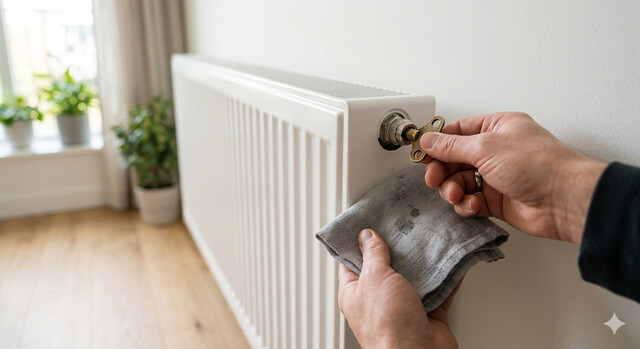
Bleeding radiator: this is how you do it step by step

Do you hear a bubbling, ticking, or sloshing sound coming from your radiator? Or is your heating warming up slower than you're used to? Then there is a good chance that there is air in your central heating system. Good news: bleeding your radiator is a simple task that you can do yourself in a few minutes. In this blog, we explain why it is important to bleed your radiators, when you should do this, and how to tackle it step by step.

Radiator-ontluchten.png
13 May 2026

Why is bleeding your radiator important?

Air in your heating system causes a lot of discomfort and unnecessarily high energy costs. When there is air in the pipes or radiators, the hot water cannot circulate properly. The result? Your radiator does not get (evenly) warm, and your boiler has to work harder to heat your home. You will see this reflected directly in your energy bill.

Additionally, air in the system can cause damage in the long term. The presence of oxygen leads to rust, which can damage vulnerable components such as the pump or heat exchanger. Regularly bleeding your radiators not only extends comfort in the home but also the lifespan of your heating system.

In short, bleeding your heating system provides:

  • A lower energy bill
  • An evenly warm radiator
  • Less noise from your radiators
  • A longer lifespan of your boiler installation

When should you bleed your heating?

There are a few clear signs that indicate it is time to bleed your heating:

  • Your radiator makes a bubbling, ticking, or sloshing sound
  • The radiator is cold at the top and warm at the bottom (or vice versa)
  • Your heating warms up slowly or does not get warm enough
  • Your energy bill is rising without a clear reason

Even without these signs, it is wise to bleed your radiators at least once a year as a preventive measure. The best time for this is at the beginning of the heating season, before you start using the heating intensively again. You should bleed the radiators when the boiler is off and has cooled down.

What do you need to bleed your heating?

You do not need much to bleed your radiators:

  • A radiator key
  • A cloth or a container to catch water
  • Possibly gloves (the water may be black)
 

Step-by-step plan: this is how you bleed your heating system

1Step 1: Open all radiators

Turn all radiator knobs in the house fully open and briefly activate your central heating via your thermostat. This will cause all the air to gather at the bleed valves.

2Step 2: Turn off the central heating boiler

Set the thermostat as low as possible and possibly unplug the boiler from the socket. Wait for about 10 minutes for the water circulation to come to a complete standstill.

3Step 3: Turn the radiator valves off

Turn off the valves of all radiators before you start bleeding.

4Step 4: Start at the bottom of the house

Always start with the lowest radiator in the house (for example, on the ground floor or in the basement) and work from the bottom up. This prevents air from flowing back into the system through the upper radiators.

5Step 5: Open the bleed valve

Hold a cloth or container under the bleed valve. Slowly turn the valve counterclockwise with the bleed key to open it. You will hear a hissing sound: that is the escaping air.

6Step 6: Close the valve as soon as water comes out

Is a steady stream of water coming out of the valve? Then all the air is out. Turn the valve back off immediately. The water may turn dark or black, that is normal.

7Step 7: Repeat for each radiator

Loop through all the radiators in the house one by one, from low to high.

KingFisher_2310_03.png

Tips for bleeding your radiators

A few handy tips to make the bleeding process go smoothly:

  • Bleed valves are always located at the top of the radiator, often on the side opposite the valve. A valve at the bottom is usually a drain, not a bleeder.
  • Always work from bottom to top. If you start at the top, the water will flow back down and leave air trapped in the system.
  • Use a cloth to catch the black water. This can leave stains on floors or walls.
  • Always check the water pressure after bleeding. If the pressure is too low, you need to top up the system.
  • Does your radiator not have a visible bleed valve? Then follow the central heating pipe to the next radiator that can be bled.

Time for a new radiator?

If your radiator is still not warming up well, even after several bleeding sessions? Then it may be that the radiator itself needs replacing, due to internal rust or limescale. At Maxaro, you will find a wide range of radiators in various styles and designs:

Want to know which colour best fits your interior? Then first order a colour sample. Check out our range of radiator valves or radiator accessories to complete your radiator.