

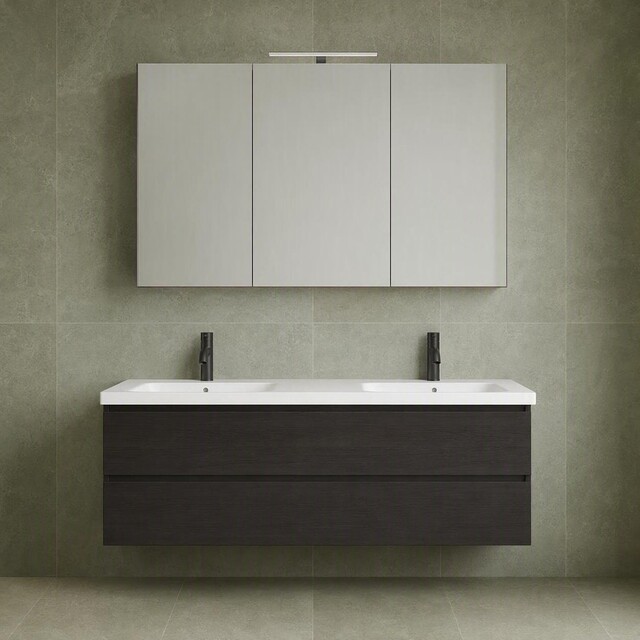
If you're in doubt between a mirrored cabinet and a loose mirror, choose primarily based on function and depth. A loose mirror often protrudes only 2.2 to 3.5 cm, while mirrored cabinets like Lento and Lato are around 13 to 15 cm deep. If you want extra storage space and items within reach, a mirrored cabinet is a better fit. If you prefer a lighter look above bathroom furniture, a loose mirror is usually more logical.
With a bathroom unit featuring a mirrored cabinet, you combine reflecting and storing in one place. If you choose a loose mirror, that storage space shifts to the drawers of your unit or to an extra cabinet.
Mirrored cabinet or loose mirror: this is the difference at a glance
The difference is simple. A mirrored cabinet primarily adds functionality, while a loose mirror mainly provides calmness and openness above the unit.
The main advantage of mirrored cabinets is the extra storage space for small toiletries. Daily items such as toothpaste, grooming products, and shaving supplies are therefore directly at hand. A loose mirror does not offer this, but does provide more freedom in shape and appearance.
This is reflected in the dimensions. A Solo bathroom mirror measuring 80 x 60 cm is 3.5 cm deep, while Lento is 13 cm deep and Lato is 15 cm. Even bathroom mirrors with lighting often remain slim, such as the Primo measuring 70 x 50 cm with a depth of 3.5 cm.
If you want storage space but less volume on the wall, then a built-in mirrored cabinet is a logical middle ground. Such a model is partially recessed into the wall, resulting in less cabinet protruding into the bathroom than the total cabinet depth might suggest.
Mirrored cabinet: smartest choice for many daily items
If you use many small products above the sink, a mirrored cabinet is usually the practical choice. You keep everything exactly where you use it, without cluttering the countertop.
This is especially convenient with a bathroom unit with sink, where the morning and evening routines take place in the same spot. Modern units often have clever layouts with siphon cutouts and drawer dividers, but storage space above the unit remains an extra advantage. Especially with more compact widths like 60 or 80 cm, where the unit itself offers less space.
If you choose a loose mirror, then that storage must come from elsewhere. Usually, you move it to the drawers of the unit or to an extra bathroom cabinet. A mirrored cabinet is therefore particularly handy if you use many small items every day above the sink.
Wall space and depth: what fits in your bathroom
If you have little walking space or want to keep the wall as calm as possible, a loose mirror usually fits better. If you want cabinet space, then a built-in mirrored cabinet is often the best compromise.
A built-in mirrored cabinet does require a wall with space for the cabinet depth, such as a stud wall or a plaster wall with sufficient space behind it. In a load-bearing wall, this is usually not possible. If you are renovating the bathroom anyway, then built-in is good to plan in advance. If the bathroom is already finished, then a surface-mounted model or loose mirror is almost always more practical.
The differences are clearly visible in the range. The Liso bathroom mirror measuring 70 x 60 cm is 2.2 cm deep, and the Primo measuring 70 x 50 cm is 3.5 cm deep. In contrast, the Modulo mirrored cabinet measuring 80 x 70 cm has a depth of 14 cm. The Trento built-in mirrored cabinet measuring 80 x 70 cm is 13 cm deep but partially disappears into the wall.
You notice this difference even more in a compact bathroom. If you already opt for shallow bathroom furniture, it pays to critically consider the depth above the unit as well. A loose mirror then appears lighter, while a surface-mounted cabinet is more visibly present.
Lighting above the unit: integrated or separately solved
For lighting, the choice mainly revolves around how integrated you want it. With both a loose mirror and a mirrored cabinet, you choose between a model with built-in lighting, or light that you solve separately with, for example, a wall lamp or ceiling spotlight.
You will find both bathroom mirrors with lighting and mirrors without built-in lighting. The same applies to mirrored cabinets. So, you are not choosing between having light or not, but between light in the mirror or cabinet, or light as a separate solution above.
Make this choice in advance. Built-in lighting is fixed in the model and cannot be added later. If you consciously choose a mirror without lighting, then plan the wall lamp or spotlight into your electrical plan right away.
Socket and daily routine
If you want to use appliances close to the sink and then neatly store them away, a mirrored cabinet often scores better. There are several mirrored cabinets with a socket, and sometimes also with USB or USB-C.
This makes a mirrored cabinet handy for shaving, blow-drying, or charging in the same place where you also store your grooming products. Some loose mirrors also have a built-in socket, so the difference is not absolute. However, with mirrored cabinets, the combination of power point and storage space is clearly stronger.
Therefore, first look at your daily routine. If you use several small products and appliances at the sink every morning, then one integrated solution often works more calmly than separate storage and power points.
Which choice fits a small bathroom, family bathroom, or guest bathroom
In a small bathroom, a loose mirror usually works best spatially. In a family bathroom, a mirrored cabinet often wins on convenience. In a guest bathroom, the best choice mainly depends on how many items are actually left behind.
For a small bathroom, the difference in depth is decisive. A loose mirror measuring 80 x 60 cm with a depth of 3.5 cm feels lighter than a mirrored cabinet measuring 80 x 70 cm with a depth of 13 or 14 cm. A built-in mirrored cabinet is a good alternative here, as it adds storage space without being so prominently present.
In a family bathroom, storage counts more. Then a wider setup, such as bathroom units with double sinks, often fits well with a mirrored cabinet. There are mirrored cabinets up to 157.6 and 160 cm wide, which makes sense for multiple daily users.
In a guest bathroom, a loose mirror is often sufficient. There are fewer daily products in use, so an open and simple wall setup works perfectly.
This is how to align your choice with the size of your bathroom furniture
First, look at the width of your unit and then consider shape and style. According to the buying guide from KOHLER, a mirror above a sink unit looks best if it is as wide as the unit or just slightly narrower. For a unit of 80 cm, you would therefore choose a mirror or mirrored cabinet with a maximum width of 80 cm.
A mirrored cabinet often aligns well with standard unit sizes. Mirrored cabinets range from 40 to 180 cm wide, and the Modulo bathroom units from 45 to 180 cm, making a cabinet often feel like a logical extension of the unit.
A loose mirror offers more freedom in composition. You will find rectangular, round, and organic models, for example, 70 cm round, 100 x 68.8 cm, or 120 x 80 cm. If you are not yet sure of the width of your unit, first read how to determine the correct bathroom furniture width.
Your choice quickly summarised
Choose a mirrored cabinet if you want extra storage space above the unit, a possible socket, and an integrated routine. Choose a loose mirror if you want less depth on the wall and can already store your items in the unit or an extra cabinet.
- Choose a mirrored cabinet if functionality weighs heavier than an open wall image.
- Choose a loose mirror if appearance and spatial effect are more important.
- Choose a built-in mirrored cabinet if you want storage space without volume, and your wall allows it.
- Always first measure the width of the unit and the available depth above the sink.